Your Child Is Already Using AI for Homework. Here's What to Do Next
By Next Gen Remote Learning editorial team · · For: Parents of children aged 10–18
Picture a fourteen-year-old's history essay that reads a little too smoothly. Not obviously copied, just more polished than anything he's written before. When his mother asks about it, he isn't defensive at all. He shows her the chat where he pasted the essay question into an AI tool, read the answer, and "fixed the bits that sounded weird".
He doesn't think he's done anything wrong. And honestly, nobody has told him otherwise.
permission and no names, put it here instead. A true example is always stronger.]*
If you have a child at secondary school, there's a very good chance this is happening in your home too. The question isn't really whether your child uses AI any more. It's whether anyone is teaching them how.
The numbers are bigger than most parents think
A 2026 survey of 1,533 students in the UK by the revision site Save My Exams found that 93% had used AI tools for schoolwork or homework. A Microsoft report published in September, based on more than 3,000 students, teachers and school leaders, put AI use at about nine in ten across all three groups, with roughly a quarter of students using it every day.
That's not a few early adopters. That's nearly everyone.
What's missing is guidance. RAND's research found that more than 80% of US students said their teachers had never explicitly taught them how to use AI, and fewer than half of principals reported having a policy on it. In England, the National Education Union surveyed 9,408 teachers in February and found that 66% of schools still had no student-specific AI policy, the same figure as a year earlier.
So children are using a powerful tool every week, and in most schools nobody has sat them down and explained the rules. That gap is where parents come in.
Why banning it doesn't work
The first instinct for a lot of parents is to block the apps and be done with it. I understand that. But it tends to fail for three reasons.
First, the tools are everywhere. They're built into search engines, phones, messaging apps and the writing tools schools already use. Blocking one site just moves your child to another.
Second, your child will need these tools later. Universities and employers increasingly expect people to use AI sensibly, and the skill they'll need isn't avoiding it. It's knowing when it helps, when it misleads, and when it's simply cheating.
Third, a ban turns AI into a secret. A child who hides their AI use can't ask you about it when something goes wrong, like a confident answer that turns out to be completely made up.
Interestingly, students themselves are cooling on the hype. A Gallup and Walton Family Foundation survey in April found that Gen Z's excitement about AI had dropped 14 points in a year. Many young people already sense that something is off when the tool does all the thinking. That makes this a good moment to talk to them.
The difference between help and cheating
The simplest way I've found to explain this to a child is with one question: who did the thinking?
If your child asks an AI to explain photosynthesis three different ways until one of them clicks, they did the thinking. The AI was a patient teacher.
If your child asks it to quiz them on the causes of the First World War, then checks their answers, they did the thinking. The AI was a study partner.
If your child pastes in an essay question and hands in the answer with a few words changed, the AI did the thinking. Your child learned nothing, and in most schools that counts as cheating, whether there's a written policy or not.
Most real use sits somewhere between those examples, which is exactly why children need a few clear rules rather than a vague warning.
Five house rules that actually work
These are rules I've seen families use successfully. Pick the ones that suit your child's age and adapt the wording.
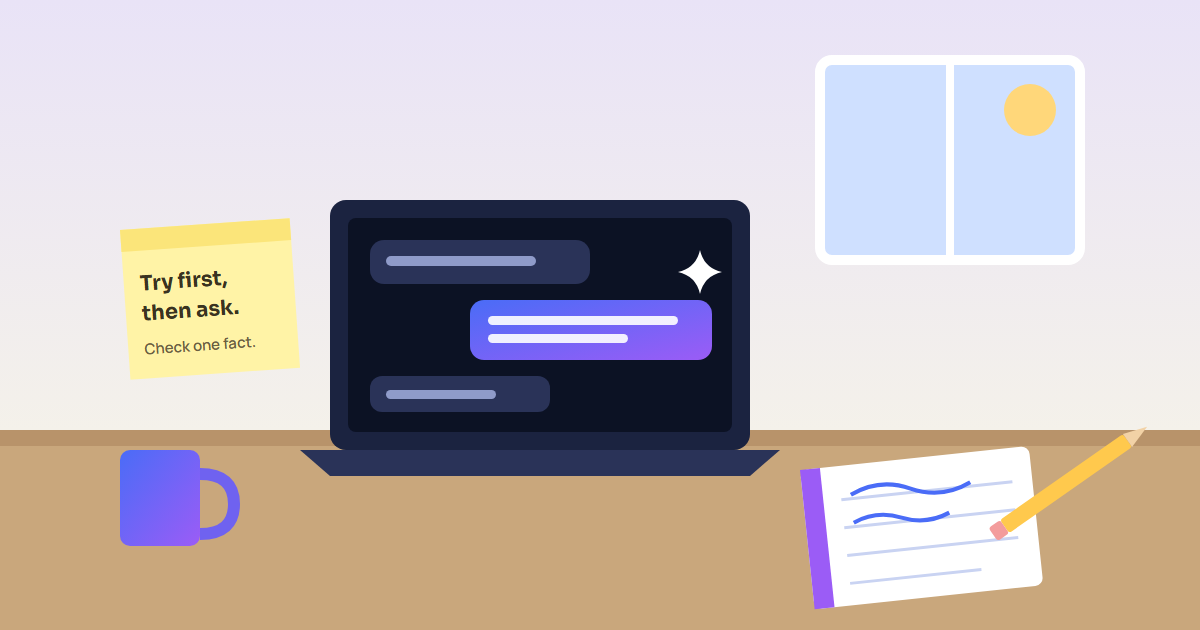
1. Try first, then ask
Before opening an AI tool, your child spends ten minutes on the problem on their own: reading the question, writing down what they know, attempting the first step. Then, if they're stuck, they can ask the AI for a hint, not the answer.
This one rule does more than any other. The struggle before the hint is where learning happens.
2. Ask it to teach, not to do
Teach your child to change the way they ask. Instead of "write my essay on climate change", the prompt becomes "ask me questions that help me plan an essay on climate change" or "explain the water cycle like I'm twelve, then test me".
It feels like a small change. It completely changes what the tool does.
3. Check one fact every time
AI tools still state wrong things confidently, including invented dates, quotes and sources. Make it a habit that your child checks at least one fact from every AI answer against their textbook or a reliable website.
It's a good habit for life, not just for homework. And the first time they catch the AI being wrong, they'll trust it a bit less, which is healthy.
4. Be open about it
If AI helped with a piece of homework, your child says so, to you and to the teacher. Something like "I used AI to check my grammar" or "AI quizzed me on these terms". Most teachers are far more relaxed about honest use than about hidden use, and your child learns that the tool isn't something shameful.
5. Some work stays AI-free
Agree on things that are done without AI at all: first drafts of creative writing, maths practice, reading set books, anything for an exam where AI won't be allowed. Exams are still written by hand in a quiet room. If a child has never practised thinking without help, that's where it shows.
What to look for if you're worried
You don't need to become a detective, but a few signs suggest your child is leaning on AI more than is good for them:
- Their homework is noticeably better than their classwork or test results.
- They can't explain, in their own words, something they "wrote" yesterday.
- Writing suddenly uses words they never say out loud.
- They avoid starting work without a device open.
If you notice these, don't lead with an accusation. Ask them to talk you through the work. A child who understood it can usually explain it, even roughly. A child who didn't will struggle, and that's your opening to agree some rules together.
Talk to the school, kindly
Since most schools are still working out their own approach, a short, friendly message to your child's teacher can help everyone. You might ask:
- Is AI allowed for homework in this subject, and for what?
- How should my child show that they used it?
- Are there assignments where you'd prefer no AI at all?
Teachers are dealing with the same uncertainty you are. The NEU survey found many are worried about students' critical thinking. A parent who asks calmly, rather than complains, is usually welcomed.
When AI isn't enough
AI is good at explaining things in a general way. What it can't do well is notice that your child has misunderstood something three topics back, or that they freeze when a question is worded differently, or that they're quietly losing confidence in a subject.
That's still a human job. For many children, a good teacher who knows them does more in a month than a year of chatting with a bot. If your child is falling behind in a subject, it's worth finding someone who can work with them one-to-one, whether that's a teacher at school, a relative who knows the subject, or an online tutor. (If you're looking, you can tell our team what your child needs and we'll help you find a suitable teacher.)
And practice material doesn't need to come from AI either. Past papers and worksheets are still the best way to get ready for exams; we keep a free collection of study materials for exactly that reason.
A conversation to have this week
You don't need a perfect policy. You need one honest conversation. Sit down with your child and ask them to show you how they use AI. Let them be the expert for a few minutes; most children enjoy that.
Then agree two or three of the rules above, write them on a sticky note, and put it near where they study. Review it at the end of term.
The children who'll do well in the next ten years won't be the ones who never touched AI, or the ones who let it do everything. They'll be the ones who learned, early, to stay in charge of their own thinking. That's something you can start teaching tonight.
Frequently asked questions
Should I ban my child from using AI for homework?
Usually not. AI tools are built into many apps, and banning them tends to make use secret. Agree clear rules instead: try first, ask for hints rather than answers, check facts, and say when AI was used.
How can I tell if my child is relying too much on AI?
Warning signs include homework that is much better than test results, being unable to explain work in their own words, and avoiding starting without a device. Ask your child to talk you through their work.
Is using AI for homework cheating?
It depends on how it is used and the school's rules. Using AI to explain a topic or quiz yourself is usually fine. Handing in AI-written answers as your own is generally treated as cheating.
References and further reading
- Save My Exams: {"heading":"The numbers are bigger than most parents think","blocks":[{"type":"p","text":"A 2026…
- EdTech Magazine: About nine in ten across all three groups
- eSchool News: More than 80% of US students said their teachers had never explicitly taught them how to use AI
- National Education Union: 66% of schools still had no student-specific AI policy
- Stacker (via KEYT): {"type":"p","text":"The first instinct for a lot of parents is to block the apps and be done…